No-Code Generative AI: How Companies Can Build Without Data Scientists
January 20, 2026
Lately, I have seen many companies eager to 'do something with generative AI' looking for help. When this need becomes concrete, they often search for in-house experts or freelancers. To my surprise, many of these companies are searching for data scientists and ML engineers, assuming this is the key to leveraging generative AI effectively.
From my experience delivering over a dozen generative AI projects for mid-sized and large enterprises, it has become clear that many companies lack a comprehensive understanding of what and who is needed for successful AI adoption. They often misunderstand the required roles, focusing on hiring specialists without considering whether these roles align with their goals. This approach can lead to inefficiencies and over-complication, ultimately hindering progress.
In this article, I will dive into these challenges and provide insights into a different approach. Instead of relying heavily on data scientists, I will explore how no-code AI solutions can empower enterprises to innovate more quickly and efficiently. By leveraging no-code platforms, companies can bypass many of the traditional bottlenecks and take a more streamlined path to achieving generative AI success.
Before we go deep into generative AI, let us discuss traditional AI projects and who is involved. With traditional AI projects, I mean projects where we have to develop the entire end-to-end pipeline of a use case from scratch, including all the model building, data wrangling and application building.
Usually, these projects look something like this:
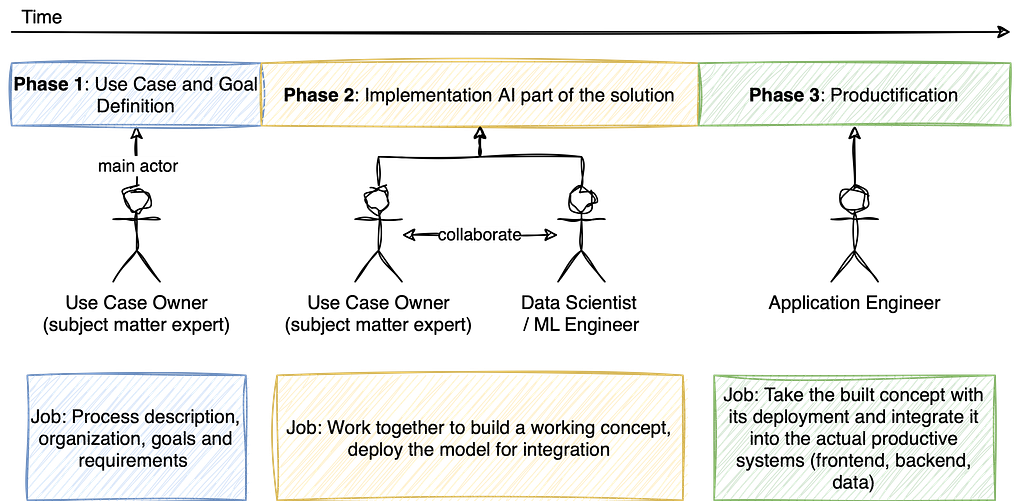
Illustration: Classical AI Projects
Traditional AI projects require several roles to bring an idea from conception to production. The roles that I am using might have different titles. However, the role descriptions that I use here are focused on the purpose, even though they have different titles for different organizations.
The first phase is the definition of the problem and goal. Subject matter experts (SMEs) are crucial here. They are the origin of the problem definition, have domain-specific knowledge, and are the source of business needs that will result in technical requirements. Subject matter experts acting as use case owners are very good at validating the output of any implemented solutions. Yet, in most cases, they are not experts in AI, and they lack the process-driven thinking patterns that are needed to create solution designs end to end.
Thus, subject matter experts collaborate closely with data scientists to identify what data is needed and what outcomes the project should deliver. Data scientists have a significant role in translating the business needs gathered from SMEs into actionable technical requirements. Their job goes beyond building models; it involves ensuring they fully understand the problem domain, extracting relevant insights, and obtaining the right input from SMEs.
They lead the next phase, which is creating a solution. Data scientists build and validate machine learning models, focusing on feature engineering and selecting algorithms. Their primary task is to experiment and ensure the model can address the identified problem effectively. They also work alongside data engineers and ML engineers to make sure the solution is feasible and scalable.
The productization phase follows, with application engineers playing a key role. I refer to application engineers as 'traditional' engineers without any particular AI skillset who can implement frontends, backends and all the orchestration (data access, DevOps etc.) in between.
They get the built models from the data scientist and integrate them into an end-to-end application for production. They build user interfaces and integrate the AI model into a working solution that end users can interact with. Each role plays a vital part in a successful project, but the complexity and reliance on specialized talent can lead to increased costs and longer timelines. This is where no-code AI can offer an efficient alternative.
The Data-Scientist-Misunderstanding
When I talk to people telling me they need data scientists because they want to start getting into gen. AI, I see two common misunderstandings: 1) What they think a data scientist does vs. what a data scientist actually does and 2) what they think is needed in a generative AI project vs. what is actually needed in a gen. AI project.
Let us look into 1). The following two pie charts show the problem pretty spot on.

Data scientist tasks: Expectation vs. reality
The first pie chart shows what people think data scientists do in generative AI projects. Many assume that data scientists spend most of their time on the model side: designing AI models, implementing them and testing them together with some data transformation work. However, the reality is that a large part of a data scientists work involves activities like data wrangling and understanding business needs, which require extensive collaboration with subject matter experts (SMEs) and other stakeholders.
The second pie chart shows what a data scientist actually does. Less than 25% of the time is spent on model building and validation. Over 30% is spent on problem understanding and stakeholder coordination - an aspect that other job roles, including data scientists, also include in their descriptions. The biggest parts of the time are spent on data gathering and model maintenance.
Keep this learning of what a data scientist actually does in their time when we look int 2) - what in generative AI projects is actually needed.
The LLM Paradigm Shift: Pre-Trained Models
Large Language Models (LLMs) are trained on massive datasets of scraped information from the Internet. In most cases, this data is openly available to everyone.
When companies talk about using generative AI, in 95% of cases, they will not train their own models in-house. Instead, they leverage pre-trained models built by other organizations with access to vast computational resources. Pre-trained models, such as OpenAIs GPT-4, are designed to understand and generate human-like responses, and they can be orchestrated into larger applications without requiring extensive additional training. They are meant to be the basis for dedicated application development that uses them over an API.
Using pre-trained models significantly lowers the barrier for entry into generative AI. Enterprises do not need to build custom models from scratch, which often demands a specialized team of data scientists, vast amounts of data, and computational power. Instead, they can tap into existing models that are ready for deployment. This allows them to focus on the application of AI to solve business problems rather than on model creation itself. Most importantly, building ones own model is very costly.
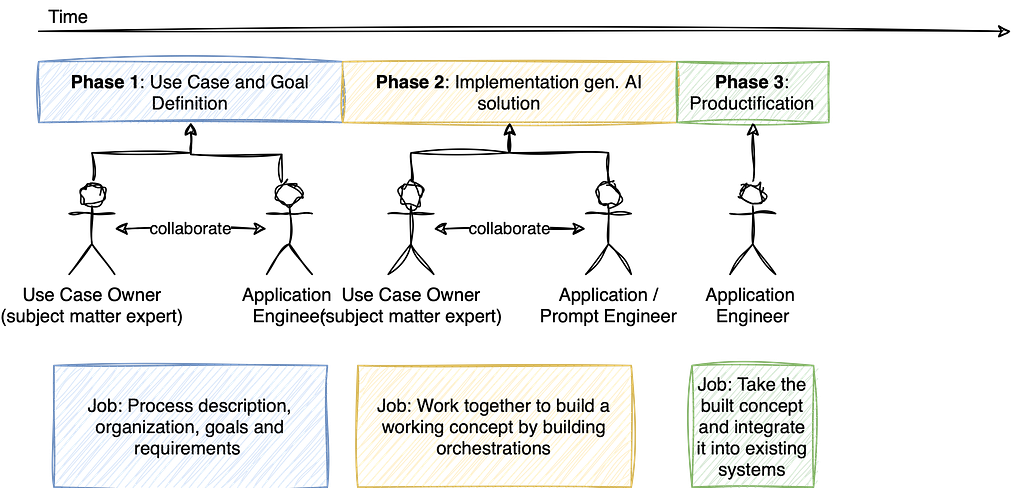
Illustration: Implementing generative AI projects
The use of pre-trained models offers key benefits, including reduced time to market and cost savings. Companies can integrate these models quickly, avoiding the lengthy data collection and training process. Moreover, they benefit from ongoing advancements made by organizations like OpenAI and Google, which keep improving these models. Using pre-trained models, businesses can focus on orchestrating these AI capabilities into their existing workflows, creating value without investing heavily in data science expertise.
With that in mind, let us have a look at what tasks you actually need to do to implement a gen. AI project.

What is needed when building a generative AI project
The vast amount of time in a generative AI project is spent on building orchestrations of models and prompt engineering, followed by problem understanding and requirements analysis and building data pipelines. Orchestration of a gen. AI model does not need the same skills as building a gen. AI model from scratch. Most models that are widely used today are available through an API - an interface that generally any application developer is capable of interacting with.
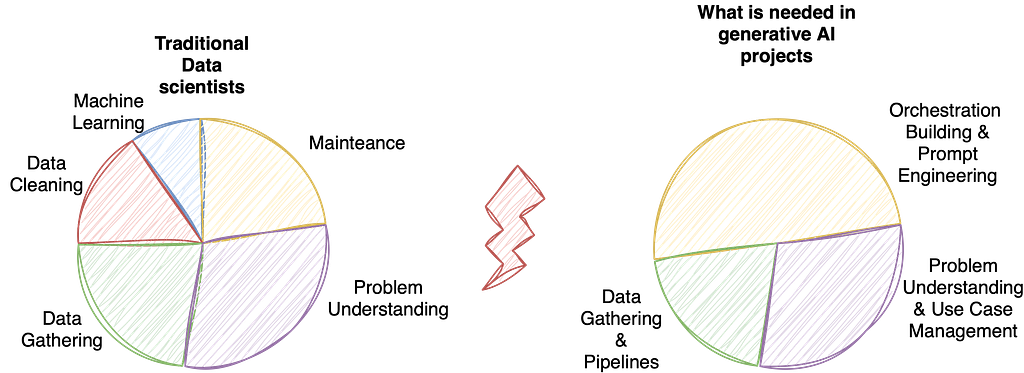
The disconnection: generative AI projects with data scientists
So when we put a data scientist on a generative AI project, only a small part of the skillset that a data scientist has will be used. Yet other skills - that are not part of a traditional data science role - are needed. This includes prompt engineering and iterative development. But l am also not somebody advocating replacing data scientists with prompt engineers - a term that is even more loosely used in different contexts than the data scientist.
What somebody who needs to implement generative AI applications end-to-end actually needs to be able to do is the following:
This description is much closer to a traditional software developer than a data scientist. It is also worth noting that for most of the tasks you have when implementing a generative AI application all of the foundational deep knowledge that data scientists have are not needed.
Building generative AI applications is much more about integrating and orchestrating already existing models in the most impactful way than building (or even understanding) the details behind the scenes.
So, I would rather put an application engineer with a bit of additional training in generative AI on a generative AI project than a data scientist. It is better for costs, efficiency and speed.
Orchestration Is Key: Making AI Work for Your Business
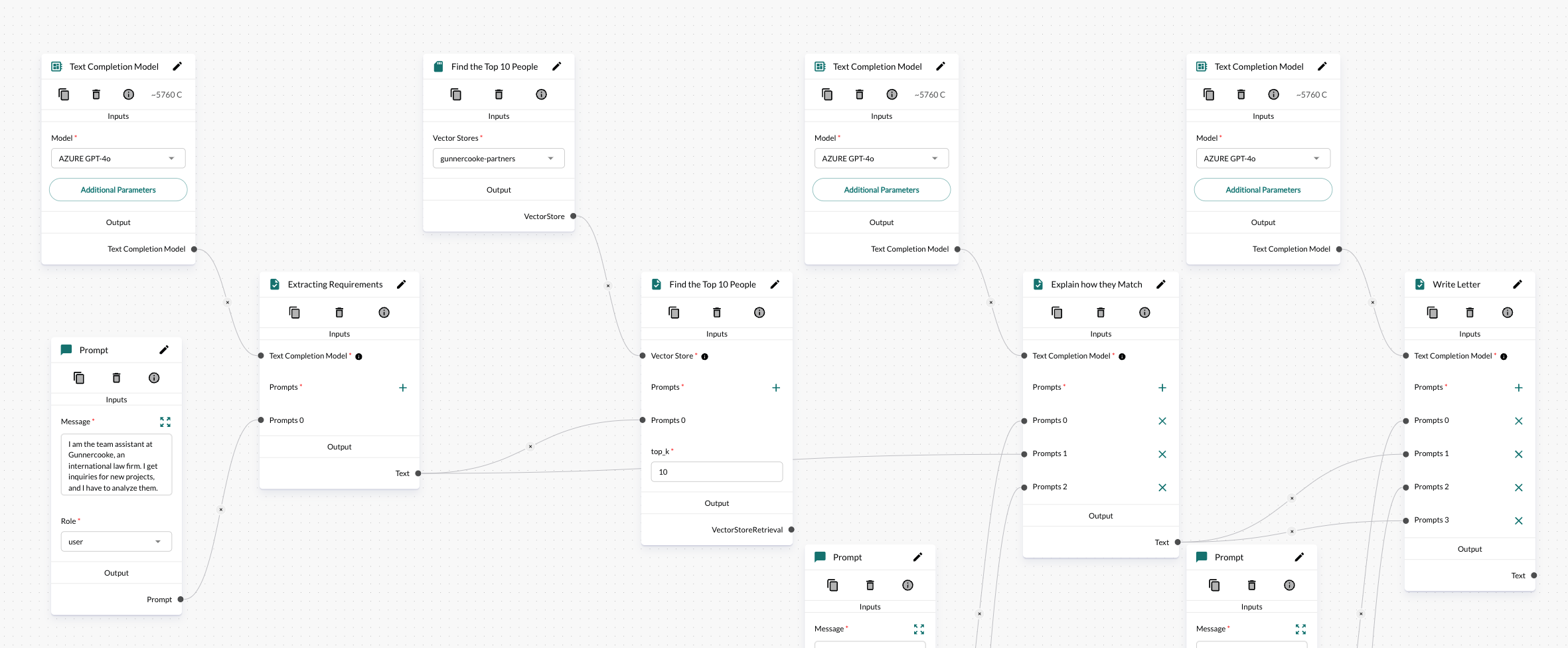
Orchestration in AI refers to creating multi-step chain-of-thought prompts that bring together data, models, and logic in manageable steps. It involves structuring workflows where different components, such as data sources, AI models, and application logic, are integrated to achieve a desired outcome. By breaking down complex tasks into smaller, handleable units, orchestration tools allow AI systems to operate more efficiently and effectively.
You can see the orchestration more as 'stitching together different pieces of fabric' in contrast to 'weaving all fabrics, making the cuts and sewing' - the metaphor for building a model from scratch.
The benefit of orchestration is that it abstracts the complexity of managing different AI components. It enables the integration of pre-trained models and data services in a streamlined way, allowing teams to focus on delivering value rather than on the technical details of each model. This is especially important in generative AI projects, where connecting models, applying logic, and iterating on workflows quickly are essential for successful implementation.
Topics that are covered in the orchestration part are: