Benchmaxxed or Brilliant? What a Broken Lava Lamp Taught Me About Choosing Models
October 13, 2026
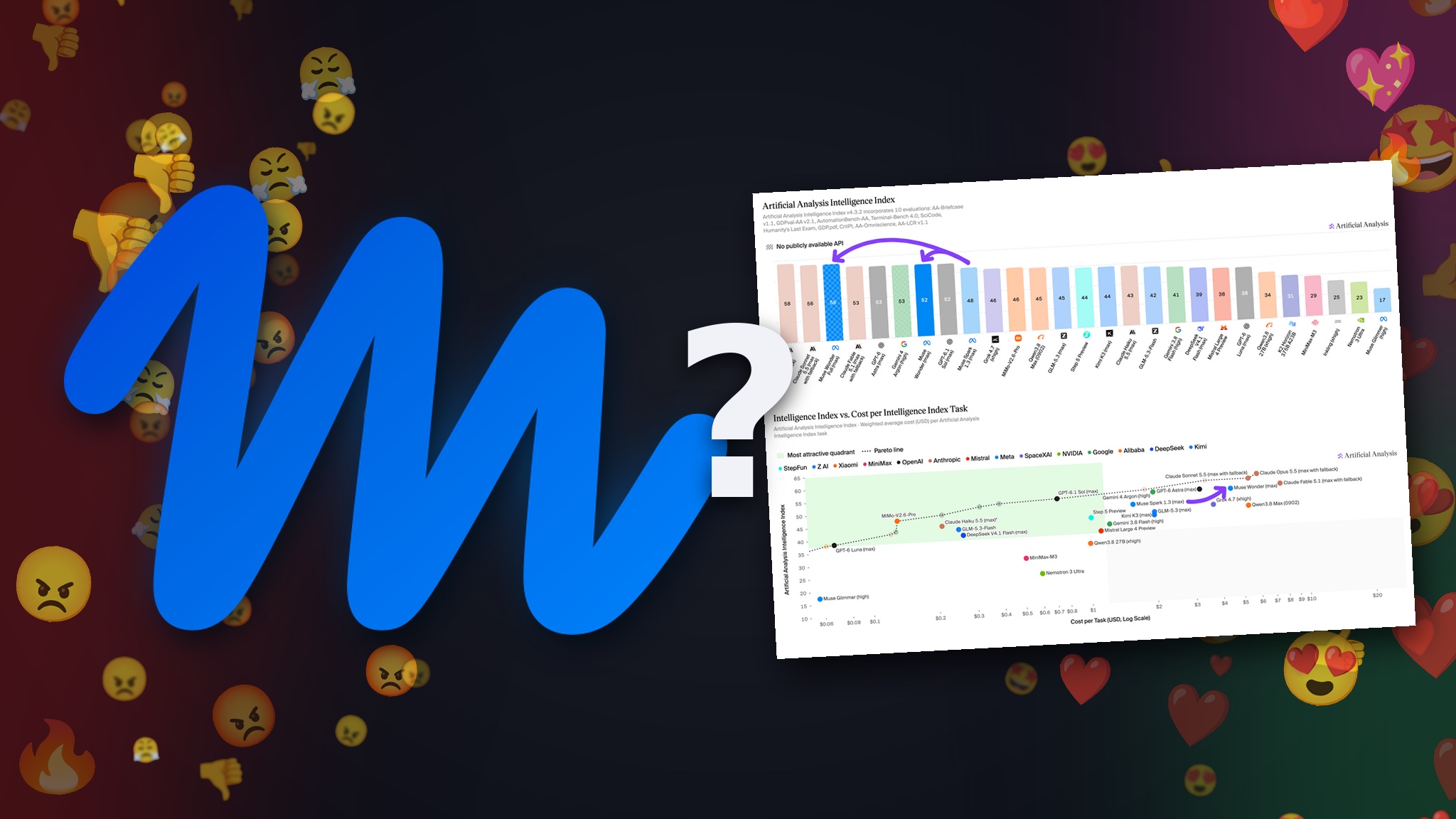
Image by the author. Chart: Artificial Analysis. Muse is a trademark of Meta.
When Meta launched Muse Wonder, I was scrolling Twitter for first user reports and found something weird. I was looking at a lava lamp with no lava in it. No glass either, just a red cylinder on a lamp base. It came from one lava lamp test that gave the same prompt to four models [4]. Three of them rendered a glass lamp with orange wax inside. Muse Wonder rendered the red cylinder.
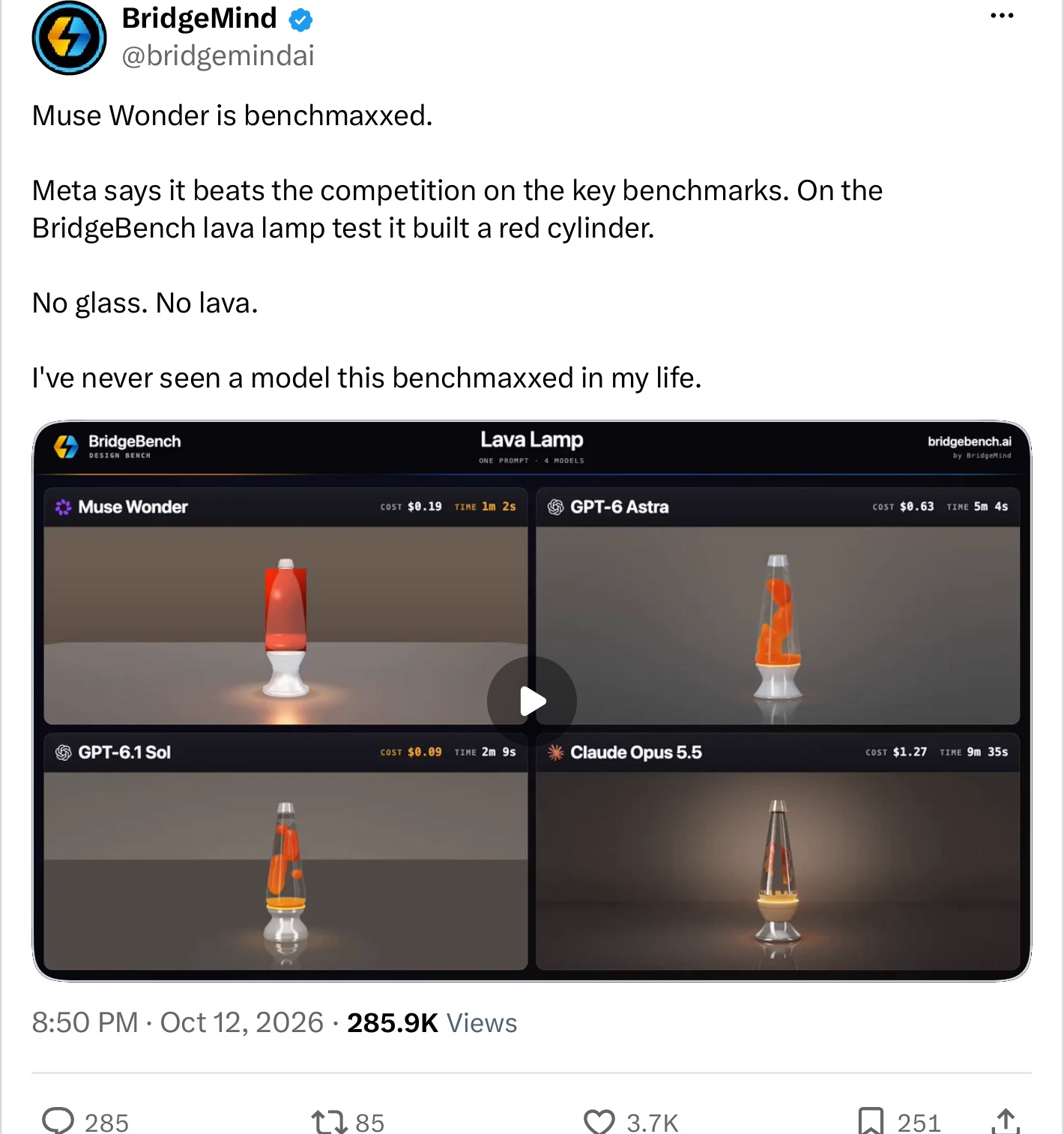
BridgeMind, 12 Oct 2026. https://x.com/bridgemindai/status/2109733498114417013
There were many similar posts like that saying the model is “benchmaxxed” (meaning tuned to perform well in benchmarks but being disconnected from the real world usage). But it is not as simple as that.
LLMs are complex, and evaluating their capabilities is even more complex. Yes, what you see on LinkedIn or X is an indicator. But people who farm engagement get more from an outrage post than from a nuance post, so keep that in mind for perspective and do not completely fall for Internet hype or a shitstorm. I do what I do with every new model: benchmarks first, then the real world.
Yes, on the independent benchmarks I would count Meta as a frontier lab now. On the Artificial Analysis Intelligence Index the bigger Muse Wonder Full scores 56, so just two points behind Claude Opus 5.5 at the top [2], and when the press calls it Meta’s first frontier model I think that is fair on these numbers [3].
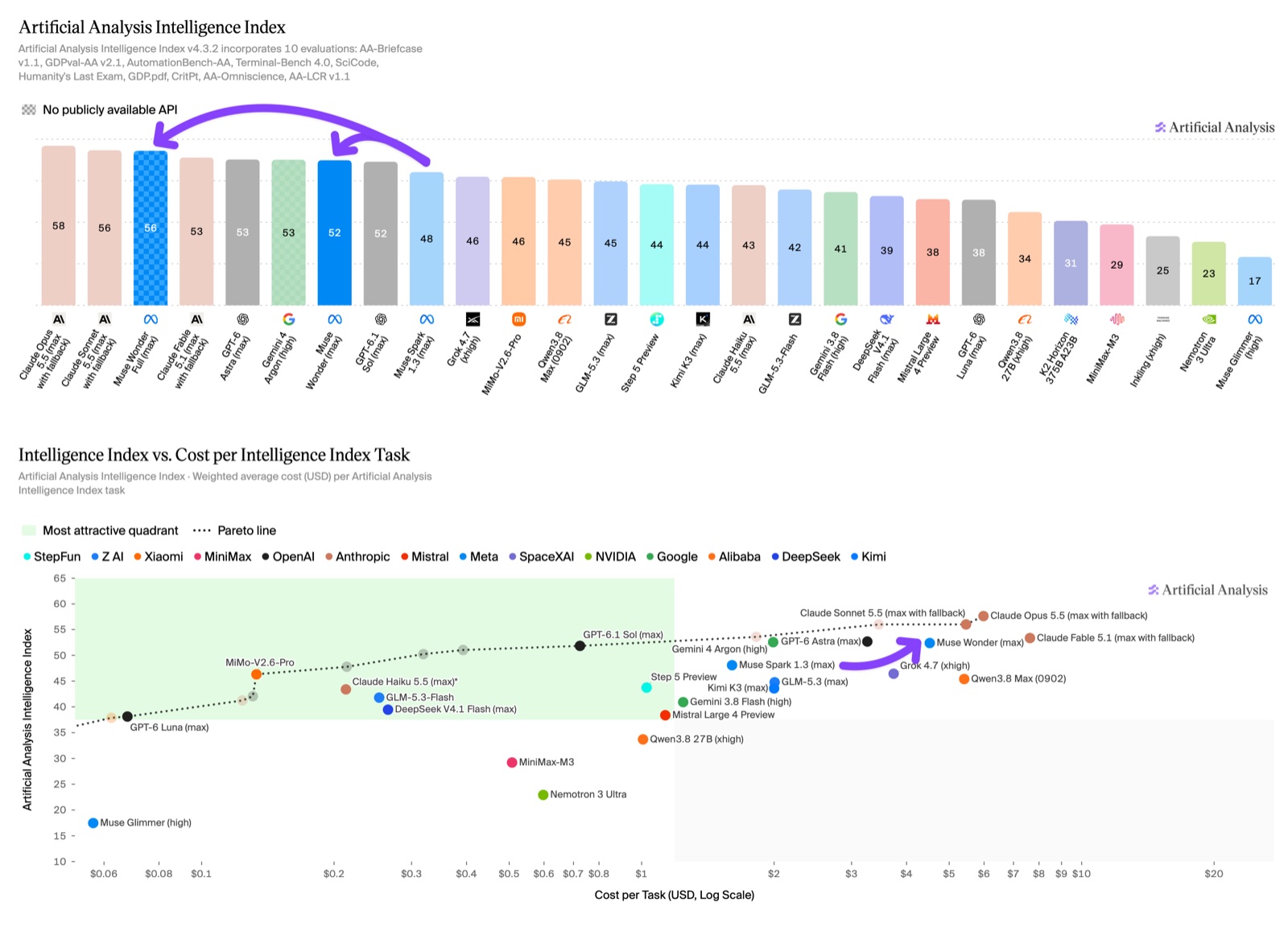
Artificial Analysis, Intelligence Index v4.3.2, accessed 13 Oct 2026. Screenshot unmodified. https://artificialanalysis.ai/articles/muse-wonder
Still, benchmarks are only the first half of my check. They can be tweaked and tuned until they generalize to nothing, so I always look at hands-on results next.
Outrage posts on X are a weak signal, because one bad render tells you very little about a model that is this complex, but I still look at them as some kind of indicator. And from the 3D screenshots I saw, Muse Wonder really doesn’t seem to do that much.
So I look at the details behind the screenshots. The lava lamp for example ran on the smaller Muse Wonder, and that run was a fraction of what the Opus run cost [4]. In the lawn mower comparison, Opus clearly made the better picture, at about 24 times the cost [5]. And Meta never trained for this. Alexandr Wang, who leads Meta Superintelligence Labs, said so himself [7].
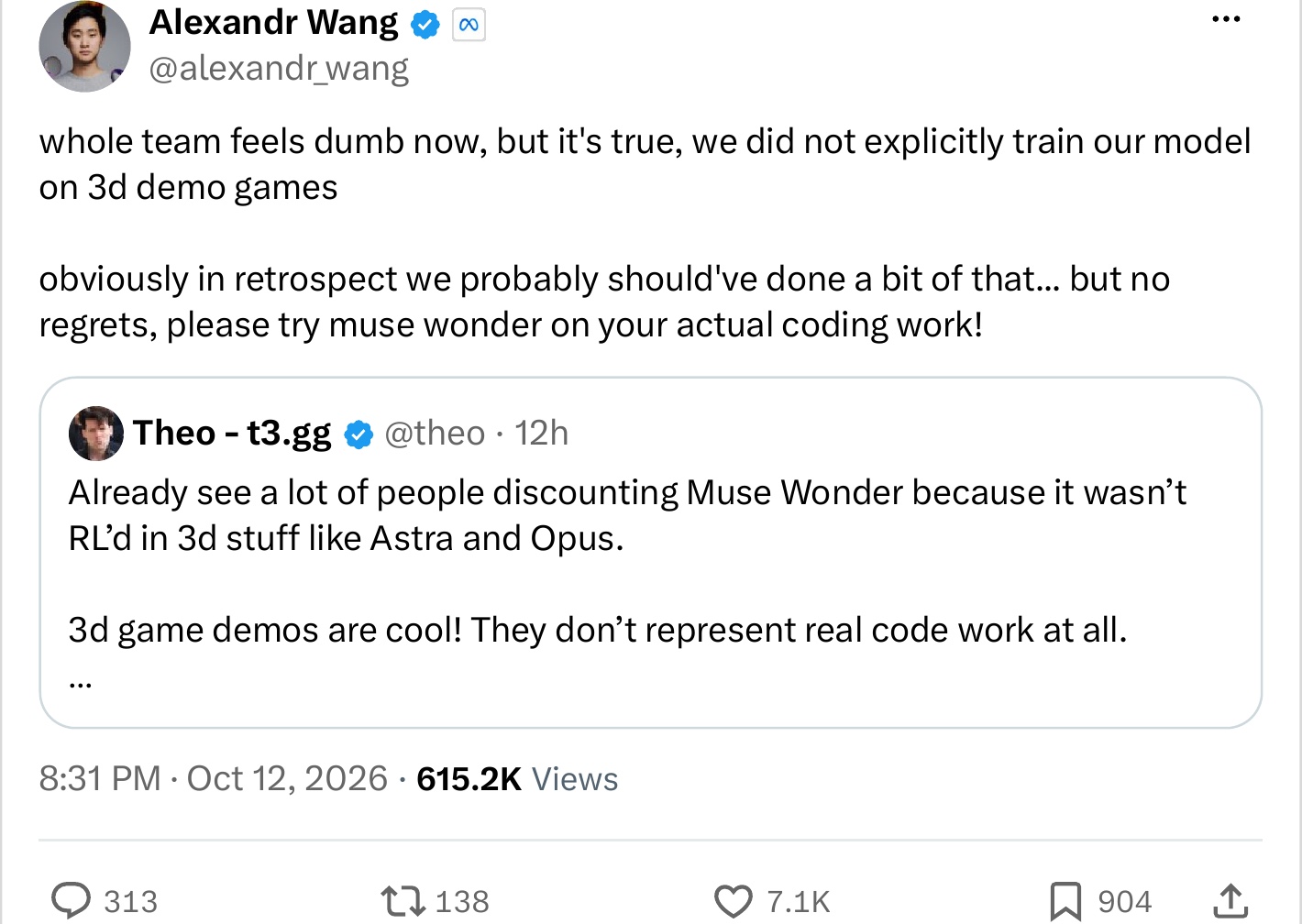
Alexandr Wang, 12 Oct 2026. https://x.com/alexandr_wang/status/2109728684802523156
So is it benchmaxxed? Honestly I don’t think you can say that after one day of people posting renders. A red cylinder and an agent benchmark measure totally different things, so the one doesn’t cancel out the other [6]. But okay, Meta kind of asked for it, the first demo in their own launch post is “a playable 3D kitchen game” [1], so you can’t really blame people for trying exactly that. For a client project that is already running, none of this changes much for me anyway.
No, and I would go as far as saying it’s a terrible idea to switch a running workflow because some benchmark went up by two points.
Model selection is a big part of every project we do, whether it’s for a customer or for our own processes, and at JadenX that’s the reason why the implementation phase takes quite a lot of time. We put different models against each other on the real process of the client and keep going until we find the one that works best for it. While we do that we build up the quality control around that model, and we get confidence in how it behaves.
So we keep a model as long as possible. A swap means a migration and a migration means doing a lot of that testing again. If there’s a real need to swap we do it, sure. But otherwise I keep the model stable until there’s a real difference in content and quality, I mean a generational difference that actually has an impact on that very specific use case, and a two-point gain on a public index is just not that.
And even if the jump is generational, in Europe you then run into the next problem, and that one has more to do with the contract than with the quality.
For a European client it’s usually the contract where Muse Wonder gets stuck. When I talk to data protection officers they want to know where the data resides and if it gets used for training, and where it’s processed. If you read Meta’s API data terms, training use depends on the service tier, and their geographic policy basically lets Meta switch access per country whenever they want [8][9].
What I do is go through the cloud providers my clients already have service level agreements with. A client on AWS with the model on AWS, that’s easy. Meta is not a major cloud provider though, and almost no enterprise has an agreement with them, so you’re looking at a whole new procurement process, new data processing agreements, and with the bigger clients custom terms on top. For most European enterprises signing Meta as a new vendor is the harder part, much harder than anything about the model.
Same thing with Active Memory, which is Meta’s headline feature. All the major assistants remember stuff now, and strictly speaking it’s the application around the model that does the remembering. If you can switch the memory on and off, fine, it’s good. If you can’t, that might be an issue for enterprise.
You choose a model for your project by looking at the process first, and the model comes later. So ask yourself, do you need a frontier model at that level for the task you have, or is something cheaper, and probably a bit faster, good enough? A back-office process doesn’t need a lava lamp, it needs a model that can do the task at a price that makes sense.
At JadenX we go through that in four steps. When a client asks me “Should we use Muse Wonder?” I start with exactly that process question. Then I look at the candidates, the independent benchmarks first and after that the hands-on tests, and then the contract, ideally through a cloud provider like AWS where the client already has an agreement. And once a model is in production it stays there, unless something generational comes along for that use case.
Muse Wonder makes Meta a credible frontier lab, but like with any other model it still has to earn its place in each process. What I take from this launch is really that you shouldn’t completely fall for Internet hype or a shitstorm. What you see on LinkedIn or X is an indicator, sure, but outrage just gets more engagement than nuance. On my feed everybody was asking if Muse Wonder is benchmaxxed, and I’d rather have my clients ask if it passes their process, at a price they accept, with a vendor they can actually sign. A good benchmark score won’t tell you that and a viral fail won’t either, you only find out by testing it on your own process.
If you want to test Muse Wonder, or any other model, against your own business process, just contact me through jadenx.com.
Is Muse Wonder benchmaxxed? I don’t think that is proven. It scores 52 (Wonder) and 56 (Wonder Full) on the Artificial Analysis Intelligence Index v4.3.2 (accessed 13 Oct 2026), even if it did poorly in a bunch of one-shot 3D tests.
Is Muse Wonder good for enterprise agents? On the independent agentic tests it looks strong. For a European enterprise I would worry more about procurement and the data terms.
Should I switch from Claude Opus 5.5? Only if it passes your own process tests and the jump is really generational. The token price is the same, so price will not decide it for you.
[1] Meta Superintelligence Labs, “Muse Wonder”, Meta AI Research, 12 Oct 2026. https://research.meta.ai/blog/muse-wonder. Meta makes no benchmark claim about 3D; its claims are about agent work and coding. Meta’s own comparison chart, as tabulated by Fello AI (https://felloai.com/muse-wonder/, 12 Oct 2026), has Wonder Full winning 7 of 14 rows against Fable 5.1, GPT-6 Astra and Opus 5.5; two of those wins are on Meta-internal benchmarks. These are vendor-reported numbers.
[2] Artificial Analysis, “Muse Wonder and Muse Wonder Full: a material jump in intelligence over previous Meta models”, Intelligence Index v4.3.2, 12 Oct 2026, accessed 13 Oct 2026. https://artificialanalysis.ai/articles/muse-wonder. Independent results at max effort: Intelligence Index v4.3.2 Claude Opus 5.5 58, Claude Sonnet 5.5 56, Muse Wonder Full 56, Muse Wonder 52, Muse Spark 1.3 48 (released six weeks earlier). Coding Agents Index: Wonder Full 68, Sonnet 5.5 68, Opus 5.5 66, Wonder 63. Wonder Full vs Spark 1.3: Terminal-Bench 4.0 from 33% to 57%, hallucination rate from 33% to 23%. Pricing: Muse Wonder $4 input / $20 output per million tokens, the same as Opus 5.5; Wonder Full is only available in Muse Code.
[3] TechCrunch, “Meta releases its first frontier model, Muse Wonder”, 12 Oct 2026. https://techcrunch.com/2026/10/12/meta-releases-its-first-frontier-model-muse-wonder/
[4] BridgeBench lava lamp test, X, 12 Oct 2026. https://x.com/bridgemindai/status/2109733498114417013. Per run, as shown in the screenshot: Muse Wonder (not Wonder Full) $0.19, 1m 2s; GPT-6 Astra $0.63, 5m 4s; GPT-6.1 Sol $0.09, 2m 9s; Claude Opus 5.5 $1.27, 9m 35s.
[5] Lawn mower game comparison, X, 12 Oct 2026. https://x.com/_MaxBlade/status/2109723440710066646. Same prompt; API-equivalent cost as posted: Muse Wonder Full $4.11, Claude Opus 5.5 $99.43 (about 24 times more).
[6] Further context on 12 to 13 Oct 2026: Meta’s own Minecraft clone run produced a working voxel world, and Meta suspected a bug in a failed public test (https://x.com/alexandr_wang/status/2109726240789905548). Meta also fixed a launch-day bug in how Muse Code counted usage limits (https://x.com/alexandr_wang/status/2109714291062620560). Design Arena ranks Muse Wonder (max) #4 for websites, 59% win rate over 276 tournaments, accessed 13 Oct 2026 (https://www.designarena.ai/models/muse-wonder-1.0). Arena had added the model to Agent Arena with no score published yet (https://x.com/arena/status/2109706854700044523).
[7] Alexandr Wang, “whole team feels dumb now, but it’s true, we did not explicitly train our model on 3d demo games”, X, 12 Oct 2026. https://x.com/alexandr_wang/status/2109728684802523156
[8] Meta, “Meta Model API Data Commitments”, accessed 13 Oct 2026. https://dev.meta.ai/legal/commitments. Standard Services content is not used for training; “Discounted Services” content may be.
[9] Meta, “Meta Model API Model Designation and Geographic Use Policy”, accessed 13 Oct 2026. https://dev.meta.ai/legal/geographic-use-policy. Meta may “enable or restrict access in any jurisdiction at any time in its sole discretion”.
About this article: I work in a dictation workflow. I speak my thoughts, and a set of AI agents helps me research sources and turn my dictation into a draft. I review and edit every line before it goes out. The opinions are my own. JadenX has no commercial relationship with Meta.
This article was first published in Deep Tech Innovation on Medium.