Why AI Agent PoCs Take 12 Months to Reach Production: Integration, QA and Procurement Run in Parallel
November 6, 2026

An AI agent proof of concept takes about 12 months to reach production because three lanes of work have to finish before go-live: the product work, the commercial work and the governance and compliance work. Omdia research presented at IBM TechXchange puts the average at roughly 12 months from a successful PoC to production, and only 22% of enterprises run agents in mission-critical production [1].
The proof of concept itself should usually take six to eight weeks. Hacking something together is pretty easy when nobody has to look at governance or compliance yet, and you can validate the value it creates in that time. After that, the work splits into lanes that run in parallel, and each of them can hold up production.
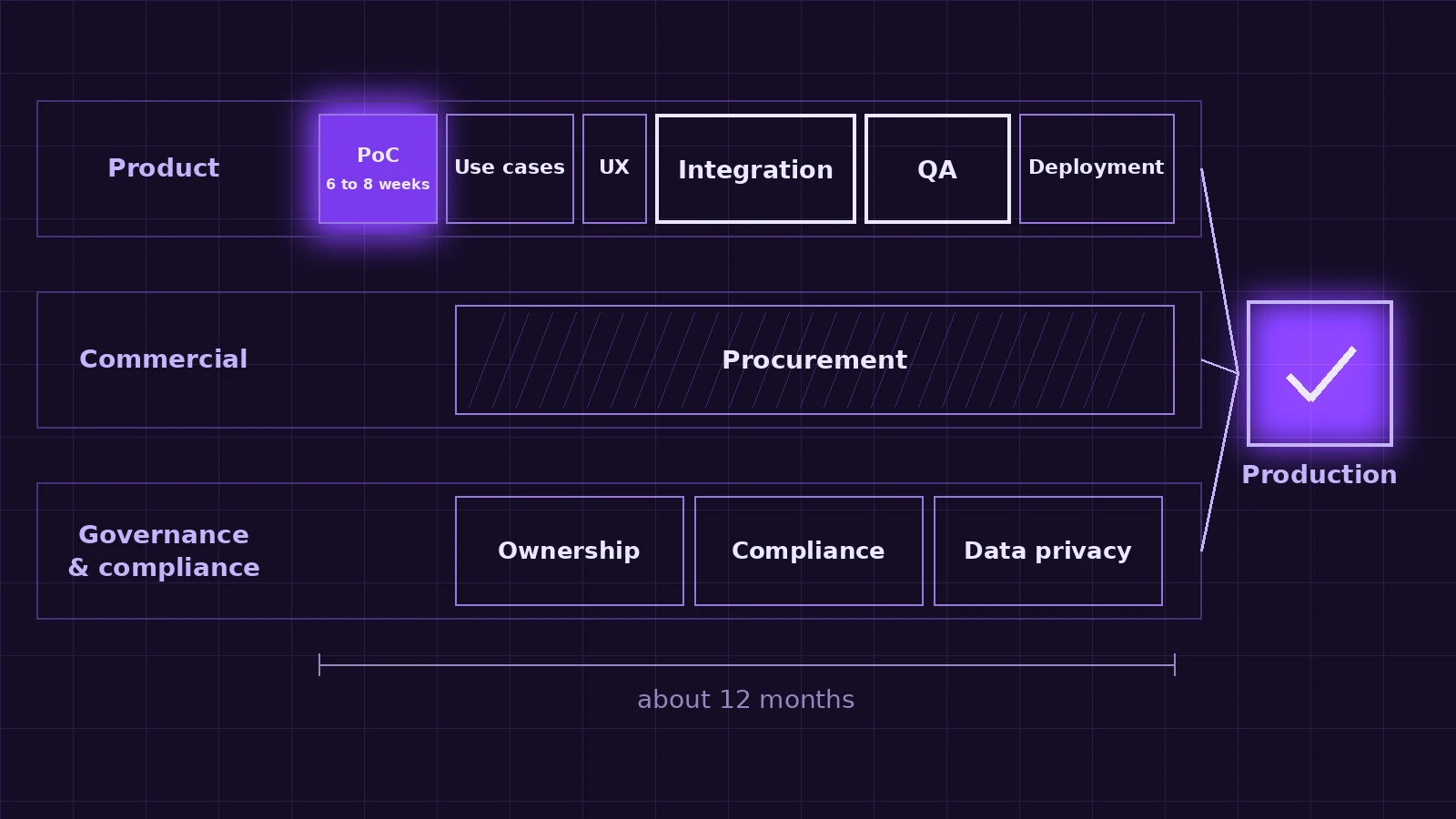
After an AI agent PoC, there is usually real product work left: you expand the use cases, tweak the user experience, integrate the agent into existing systems, test it, and deploy it. The proof of concept sits at the start of this product lane, and deployment belongs to it as well.
Integration is a big part of this work, and every AI agent project has to plan for it. In enterprises specifically, you have many existing systems that you want to integrate into your new system, or the other way around. In my experience, the smaller the company, the fewer systems and the less complexity you have.
Testing and QA take a lot of time too. For the proof of concept, you only have a small, very clear set of cases. Then you expand the use cases a little more and a little more. With every step, you have to find the edge cases, fix them and test again. That is where a lot of the time goes, and it has to be in the plan from the start.
Next to the product lane, two more lanes slow an AI PoC down. The governance and compliance lane asks who maintains the agent and who takes care of it once the project team is gone, and it covers compliance and data privacy. The deployment choice, which is part of the product lane, feeds into it: does the agent run in your own Microsoft Azure or AWS account, or in a third-party SaaS?
The commercial lane is procurement, and it can make the whole path very, very long. When the solution means buying another SaaS, the whole procurement cycle starts, and procurement departments get involved. IBM works in a very specific sector, yet I have seen the same pattern in many different sectors: projects get run down in the procurement cycle.
Procurement and legal departments block AI agent projects because, this year, most of them still have little knowledge of what privacy, governance and liability mean for these AI systems.
Let me give you an example. I have had contracts where we sold software as a service to a client, and the service used OpenAI. The client's legal department wanted us to take over all of the liability that in the end stems from the model. For a large provider, that may be something to negotiate. For many companies, and for smaller SaaS providers specifically, it is simply not possible. That is another layer of complexity on top of everything else.
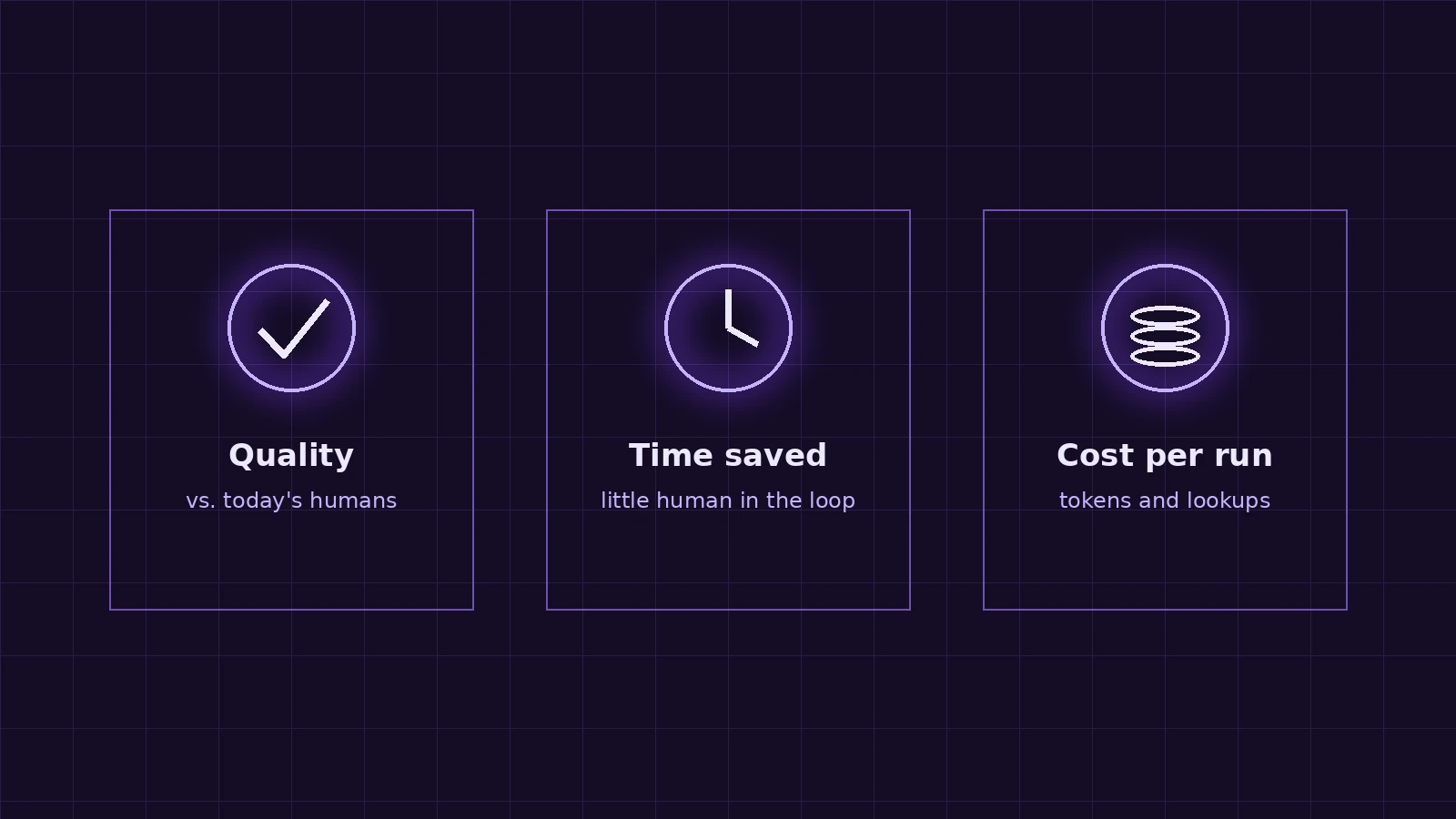
An AI proof of concept should not go to production when it fails on value, on time saved or on operating cost. I check these three criteria in this order.
Value at the quality level. The agent has to create the quality the task needs. Yet people make the mistake of thinking it must be perfect. At the moment, humans do that work, and these humans are not perfect either. Human agents are also not always right. Sometimes, as a little joke, human agents also hallucinate. Of course they should not, but the bar is the quality you have today, not perfection.
Time improvement. If the agent needs so much human in the loop that you are barely saving any time, it is not good enough.
Operating cost. Cost is the biggest problem. I do not mean the one-time implementation. I mean the operational level: when the agent has to spend so many tokens and so many lookups in knowledge bases that each run costs more than makes sense for you.
From what I have seen in Mittelstand companies, 22% going to production seems about right [1]. The number depends less on the technology than on who owns the project.
When I work with people very high in the organization, and with somebody from the department that actually has to use the agent, the chances of reaching production are much higher. When an innovation department guides the project, the chances are lower. That is my personal experience.
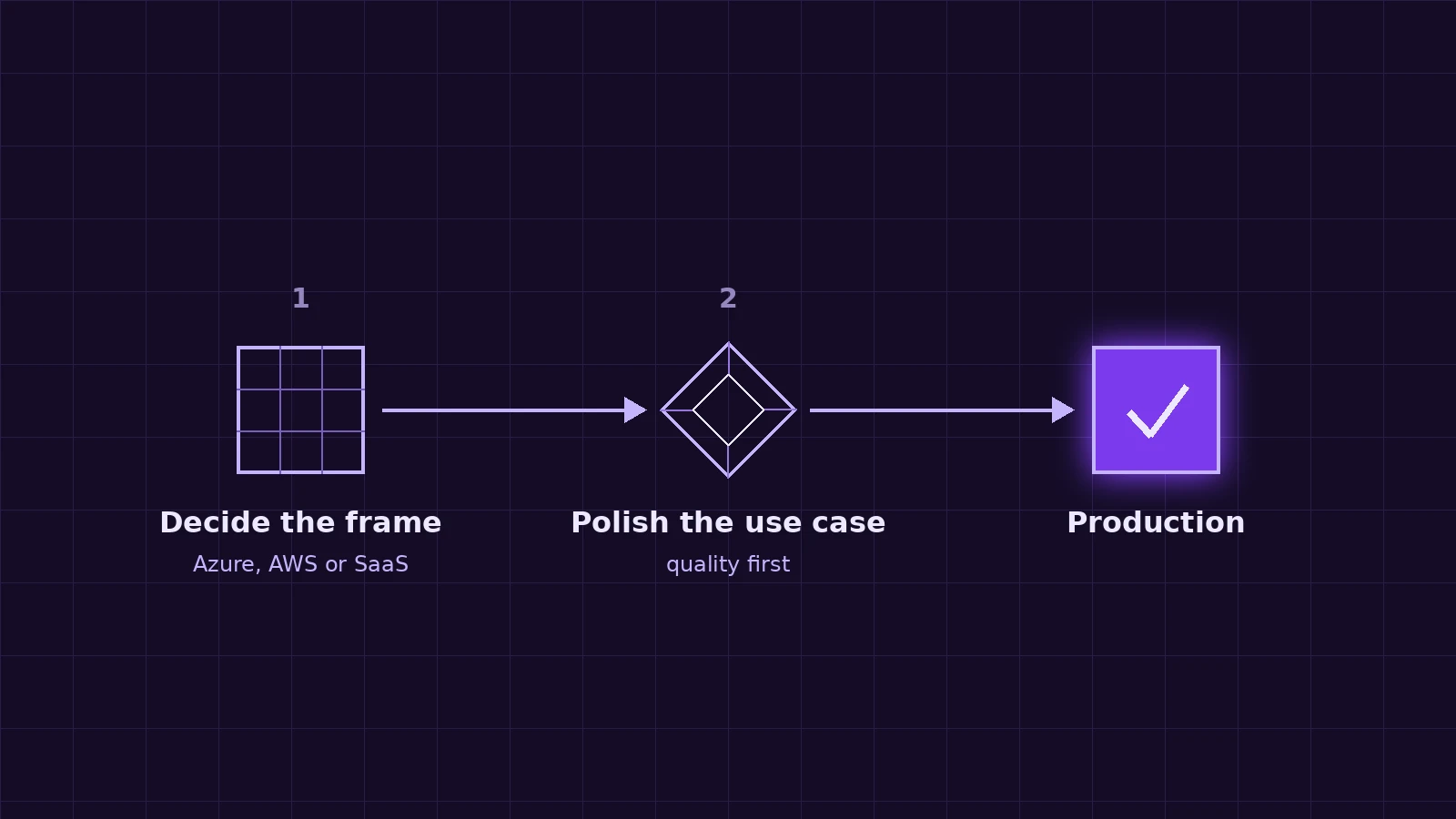
At JadenX, the first agent starts with a decision about the frame, not about the model. We try to eliminate all of the overhead from compliance and governance by making one high-level technology decision at the very beginning. For example, if a client already deploys in Microsoft Azure, we deploy the agent there, and with that we should generally be fine.
After that decision, we focus only on the use case. We polish it and make it as good as it can possibly be. That includes the product work: the use cases, the integration with existing systems and the QA on the edge cases. And with that, most of the agents we build actually go to production.
A company should decide where the agent will run, who will own it and which department will use it before the PoC starts. It should also plan the product work after the PoC, above all the integration with existing systems and the QA as the use cases grow.
How long should an AI proof of concept take?
In Dr. Marcel Müller's experience, an AI agent proof of concept should usually take six to eight weeks, because validating value does not yet require governance or compliance work.
Why do AI pilots get stuck before production?
AI pilots get stuck in three parallel lanes: product work after the PoC (more use cases, UX, integration with existing systems, QA on edge cases, deployment), procurement, where legal departments may ask the provider to carry all liability for the model, and governance, compliance and data privacy.
Why is integration a big part of an AI agent project?
In enterprises, there are many existing systems to integrate into the new agent system, or the other way around. In Dr. Marcel Müller's experience, the smaller the company, the fewer systems and the less complexity there is.
What are the criteria to stop an AI PoC?
Stop an AI PoC if it does not reach the quality humans deliver today, if it needs so much human in the loop that it barely saves time, or if its operating cost in tokens and knowledge-base lookups does not make sense.
How can a company get an AI agent into production faster?
Make one high-level deployment decision at the start, for example to run the agent in the cloud account the company already uses, and then put all effort into the quality of the use case.
Who should own an AI agent project?
A senior person from the department that will use the agent. In Dr. Marcel Müller's experience, such projects reach production much more often than projects that an innovation department guides.
[1] Torsten Volk, "IBM TechXchange 2026: Agents scale when the model has less to guess", TechTarget, 3 Nov 2026. https://www.techtarget.com/news/ibm-techxchange-2026-agents-scale-when-the-model-has-less-to-guess/873672/
[2] This article was written with AI assistance from Dr. Marcel Müller's own voice answers. All opinions are his.
If you have a PoC that works and still waits for production, or if you plan your first agent, book a free first conversation with me. Together we check the framework decision, the integration effort, the three go-live criteria and the fastest path to production, and we pick the JadenX transformation package that fits.